Posts

Pressure in Popcorn Lab

Image
1-4) calculations, conversions, and formulas used are all listed above. found our total pressure was 21.3 atmospheres. initial mass was .0033 mole of H2O. 5. The atmospheric pressure we receive daily throughout our lives is constantly around us while the pressure of the water vapor in the kernel was trying to escape and the pressure on the kernel eventually could not endure any more and became popcorn 6. I believe not all the kernels popped due to differences in the amount of water in the kernel, the more the water the easier it was to pop but the kernels with less water had a harder time to pop 7.A potential error for this lab could be the exact temperature at which the kernels popped because if kernels pop at different times there can be differences in temperature.

Hall of Fame event EC

The Bellarmine Hall of Fame Event was a very special experience that i am very grateful to have witnessed. The Hall of Fame honors former Bell graduates who have excelled as athletes, scholars, business men, men of fine arts, science/ medicine developers or men who have taken a big role in serving our community are given the chance to celebrate their accomplishments. For me it was inspiring to see former Bells come back to the community to inspire and share their accomplishments/ knowledge with current Bellarmine students. Each and every person nominated clearly showed ignation values and acted as men for and with others. Truly inspirational and i am grateful to have had the chance to come to this event. Someday i hope i can be up there just like them.

mentos

Image
the chemical reaction that takes place when dropping a mento into a bottle of soda is called nucleation. What causes the pressure is the build of carbon dioxide in the plastic container of the coke. Boyles law can be used to explain this because there is a build up of pressure which caused the bottle to fly up into the air. In my opinion the reason why the bottle flew up was because of the drastic increase in pressure.

Limiting reagent lab

Image
 1. What are the limiting and excess reagents for each flask? How did you determine this? the limiting reagent was the sodium bicarbonate because during each test it was completely used. while the excess reagent is the vinegar because there was always some vinegar left. 2. How is the amount of product in a reaction affected by an insufficient quantity of any of the reactants (reagents)?  The amount of product is reduced because if there is an insufficient amount of any of the reactants then only so much of the final product can be made until there is only one of the reactants remaining. 3. Which balloon was the largest? Explain. The largest balloon was the purple balloon because it had the largest volume from pouring in the most sodium bicarbonate which caused a reaction that produced the most CO2 filling the balloon  4. Which balloon was the smallest? Explain. The blue balloon was the smallest because in contrary to the purple the lest amount of...

electrolytes and conductivity lab

Image
Today in chemistry, we used pennies, a vinegar-water-salt solution, matboard to construct a battery to power an LED light. We started by first collecting five pennies and shaved the copper off of the tails side. We then created a vinegar/salt solution in which we dipped the matboard into. To construct our battery, we would place a penny shaved side up, then place a soaked piece of matboard on top of it. Finally we placed an unshaven intact penny at the top of the stack and place an LED on each end of our battery. Our end result lit up, causing us to then question the factors that caused this. for example, we placed more pennies onto the battery which ultimately made the LED light up brighter. In this lab I think that the solution soaked onto the matboard was a source of chemical energy and conductivity through acetic acid, sodium, chloride, and water, which was converted into an electrical current and passed through the pennies zinc and copper makeup, then finally through the lea...

Reactivity of Metals

Image
Sodium Calcium Lithium Start color for all elements All elements total  Aluminum and Magnesium Analysis - From this lab I learned that different elements have different reactions when placed in an acidic solution. Sodium and Lithium reacted the fastest quickly changing the color from an acid which is red to a base which is the color blue. The other 2 elements, Magnesium and Calcium took much longer but eventually turned the red liquid to blue. Aluminum never turned from red to blue.  What causes this reaction is when an element is placed in the acidic solution causing it to loose one of its valence electrons. What went wrong - first the lab took a very long time to actually record all the results a total of three days. Second the lab was very dangerous. Third there was unmeasured amounts of each element throwing off some of the accuracy.

Mendelian lab graph

Image

Mendelian Lab Project

Image
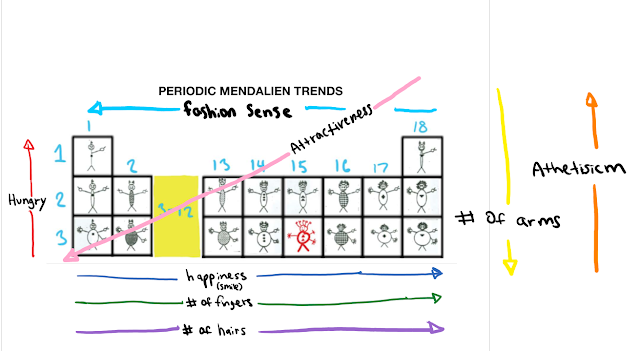
The unknown mendelian belongs in the third row and 15th group lying along where the element phosphorus is placed. Questions    Analysis:  Mendelians represent a specific element upon the periodic table. Amount/ type of fingers, hair, clothing, body shape, and arms gives properties of different elements.  How these factors actually identify an element is explained to the right-->

Rydberg's Constant

Image
 Borh's atomic model attributes hydrogen's emission spectrum to electrons dropping from higher energy to lower energy orbits.  The quantum mechanical model assumes that electrons have wave properties Electrons occupy three dimensional regions of space called atomic orbitals. 

Identify Compounds- Mini lab

Image
Analysis: 1)   it's known that all the compounds tested contain chlorine. Therefore it is safe to assume that the other elements the compounds tested are all different. This is because each element has its own line spectra, which is the color seen when it's tested on a spectrogram. 2)  Atomic emission spectra  are created when  atoms  of an  element  have energy added to them (by heating, or running electric current through an  emission  tube filled with a gas). With the naked eye, you see a single color of light (which is the sum total of all the colors of light produced by a given element )   3) Element 1: Orange-green: Possibly could have been Barium Element 2: Orange: Possibly could have been Strontium Element 3 : Orange-Pink: Possibly could have been Lithium Element 4: Orange-purple: Possibly could have been Potassium Element 5: Orange: Possibly could have been Calcium Element 6 : Pink: Possibly could have been Radium

Electron Haiku

Covalent bonds form Creating shared electrons A non- metal bond

Light Spectrum

Image
 The Sun:                                                                                               The Light Spectrum Device                  Florescent light source: LED light source: For each light source we could identify thin spectrums of light that were carried across the CD. The LED light was the easiest of the three to see we saw more colors compared to the other two sources. The florescent light was the second most colorful spectrum we found this light source at Cindy's.  The last and hardest source to see the spectrum of light was the sun. It was too bright and it made it hard for us to actually see and identify the colors inside the spectrum.
Image
Dye Separation Lab 1) we could distinct two colors. Those colors are yellow and teal. 2) we see different colors on the filter paper because the water separated the colors from the original pulling out different hues throughout the paper as the water soaked the ink 3) Our chromatography was did not have a lot of color because we did not use mr. Wongs ink and we think that blue dye does not work as well as the black dye.

Dimensional Analysis

Dimensional Analysis-  is a problem-solving method that uses the fact that any number or expression can be multiplied by one without changing its value. Five factors are used during dimensional Analysis: Time  Mass Length Temperature  Electrical Current Units of the following: 1) The unit for Time- Second 2) Unit for Temperature- Kelvin 3)Unit for Length- Meter 4) Unit for Mass- Kilogram 5) Unit for Electrical Current- Ampere Famous scientist G.I Taylor uses Dimensional Analysis to estimate the size of the atom bomb       -Taylor came to the understanding that the bomb was around 20 kilotons In other words as stated in the video, the bomb could compare to around 20,000 tons of TNT  Through this video i learned 5 things  What dimensional analysis means and how to use it.   The five factors used in dimensional analysis.  The standard units for these factors.  The physicist G.I Taylor, tha...

Intro to Chemistry

1)  Chemical changes through chemistry can be seen in our daily lives. (For example, a piece of bread turning to mold, or milk turning souring.) Its very interesting that basic everyday things around us are causing chemical reactions, 2) I found it very impressive that they are more than five types of chemistry including, physical chemistry, organic chemistry, inorganic chemistry, analytical chemistry, and biochemistry. This opens my eyes to how large the world of chemistry is. Organic chemistry- is the study of chemicals containing carbon.  inorganic chemistry- the branch of chemistry that deals with inorganic compounds. Biochemistry- is the study of chemical processes within and relating to living organisms.   physical chemistry- the branch of chemistry concerned with the application of the techniques and theories of physics to the study of chemical systems. analytical chemistry- studies and uses instruments and methods used to separate, identify, and quan...